
Mapping the Biomanufacturing Workforce

Insights and Data
Mapping the Biomanufacturing Workforce
Nearly 4 million U.S. workers hold roles tied to biomanufacturing, forming a critical talent base for national competitiveness and supply chain security.
Biomanufacturing is no longer a niche activity. Across the country, nearly 4 million workers already hold roles tied to biomanufacturing, forming a critical talent base for national competitiveness, supply chain security, and defense readiness. Much of this workforce is concentrated in major metropolitan regions that anchor scientific, analytical, and industrial production roles.
Where the Workforce Is Concentrated
Just ten metros account for more than one million biomanufacturing-relevant workers. These regions are the backbone of the national system, offering both scale and depth of expertise.
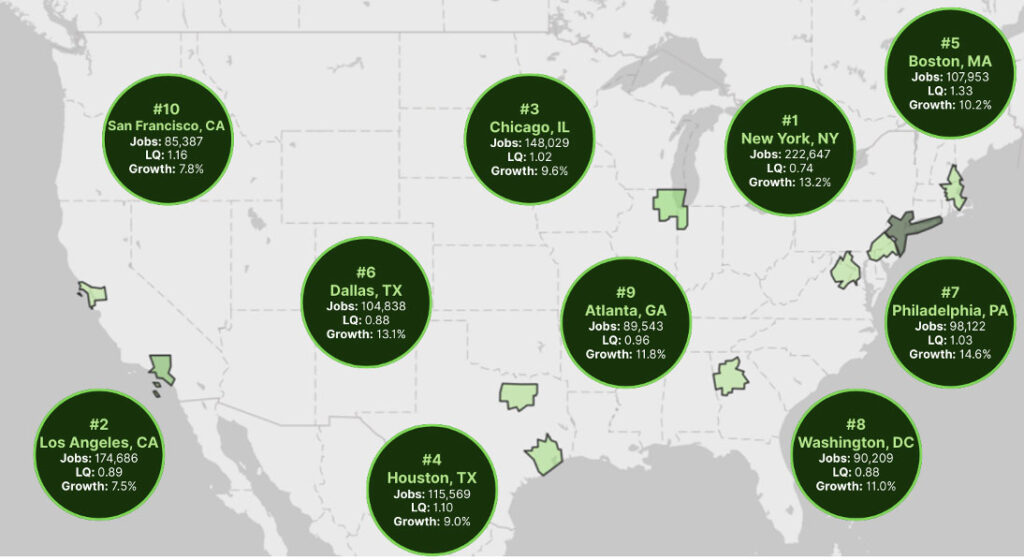
The map highlights the top ten hubs, from New York and Los Angeles to Chicago, Boston, and Houston. Each market brings a different mix of size, specialization, and growth. For example, New York holds the largest number of workers overall, while Boston stands out for its high level of specialization. Cities like Atlanta, Dallas, and Washington show strong growth trajectories that position them as rising anchors in the field.
Education Pipelines Strengthening the System
The workforce story is reinforced by education output. U.S. institutions produced more than 350,000 completions in biomanufacturing-related fields in 2023, with many of those graduates located in the same regions driving employment.
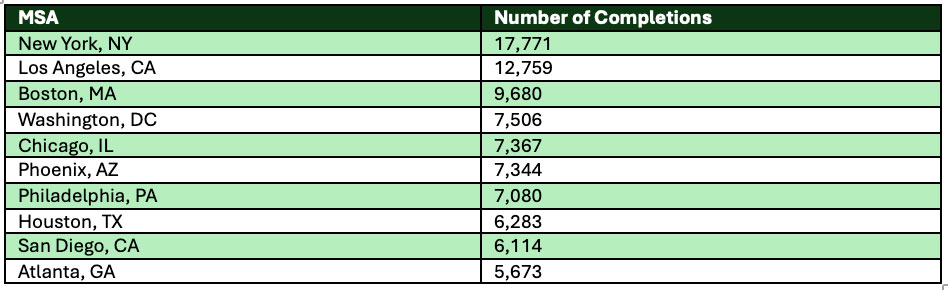
New York, Los Angeles, Boston, Washington, and Chicago top the list, but emerging markets like Phoenix and San Diego also stand out. These regions may hold significant future capacity as employers expand operations and talent pipelines continue to grow.
Why This Alignment Matters
Understanding the geography of biomanufacturing talent goes beyond identifying where workers live. It helps industry and government partners make targeted decisions about facility placement, workforce investments, regional partnerships, and supply chain expansion. It also highlights where emerging hubs are growing fastest and where education pipelines may outpace current industry demand.
Moving From Mapping to Mobilizing
Together, this distributed workforce represents one of the nation’s strongest competitive advantages. The next step is aligning talent, training infrastructure, and regional strengths with the needs of future biomanufacturing facilities. Mapping where workers and graduates are located is the foundation. Mobilizing that talent is how the U.S. strengthens its bioindustrial capacity, secures supply chains, and maintains long-term competitiveness.